Outpost Earth Blog Directory
Add to Technorati Favorites
Showing posts with label vietnam. Show all posts

Monday, March 24, 2008

Food for taught - part two

Good evening all! As promised, here are a few more market shots from Vietnam. Have a good beginning of week everyone! :-) H.


Saturday, March 22, 2008

Food for taught - part one

Hello everyone,

My previous post was suppose to be my last one about Vietnam but then I realised that I barely talked about one of my favourite thing to do while traveling: visiting the local markets.

And the food markets in Asia are definitely worth a visit. Full of life and colours and strange food, they are a shutterbug AND an epicurean dream. I guess that would explain why I love them so much… ;-) So I couldn’t resist doing one – or two – extra entry about Vietnam.

But doing justice to the markets I visited in Vietnam only in with words in extremely difficult. The experience is too sensual, to intense. Between the roasted meat smell mixing up with a more muddy, fish like perfume, the sounds of locals chatting and going around there business, the fun and new colours and shape of food you’ve never seen before and the occasional escape of a chicken or eel cutting you off, you’ll always be busy.

So instead of loosing myself in words, here are a few pictures taken in the many Vietnamese markets I visited. They can never do justice to the real thing but I hope they’ll inspire you to swing by the local food market on your next trip.

Happy Easter everyone! H.

Thursday, March 20, 2008

Lucky girl - in HCMC

It just seems like I have all the luck in the world... Now considering that I'll be going to Vegas soon, luck is a good thing to have with you!

Am actually the lucky winner of two tickets on Alaska Airlines. Now considering where they go, I'll have some tough decision to make: Hawaii or Anchorage? Will keep you posted on how it goes....

Back to my Vietnamese account, a final note on the Mekong Delta and our return to HCMC. While in the Delta, we also visited impressive pagodas. One of the most impressive one was located in My Tho, the usual base for Mekong Tour as the city is very close to Saigon.


Vinh Trang Pagoda is a quiet and beautiful sanctuary. While visiting the temple, we got lucky enough to meet one of the monk who treated us to a spontaneous and inspired talk on spirituality and the power of soul. It was priceless and a unique and a nice end to this part of our adventure.


After our Mekong tour, we drove back to HCMC and only stayed there two days before we had to head back home. It was the end of our trip and we were getting pretty tired so we stayed low. We only did two things while in HCMC: visit the presidential palace.


Now call the Hall of reunification, the presidential palace is located in ward one, the down-town district of HCMC, where you'll also find the colonial City Hall, Ben Than Market, art museum and the former U.S embassy.

The Hall of reunification allows traveler in intimate encounter with Vietnams icon 'Uncle Ho'. The visit takes us through the official and formal rooms but also deep under the building in Ho Chi Minh Bunker. Visitors are also treated with a propaganda documentary on the famous president's life.

A visit to the palace makes for a nice eye opener especially if your coming from the north. It's very interesting to hear what the people have to say here about the communist regime. Many Saigonese were forced out of the city to country re-education camp or were strip of their belongings for the good of the regime. A human reminder that in conflict, one person's victory is another one's lost....

Have a great one everyone! H.

Monday, March 17, 2008

Mekong blues


Hello everyone! Hope you are all had a very good St-Patrick and that you’ll now be able to get the rest you surely deserve…

Getting back to the trip. After our visit to the Cu chi tunnels, we headed to the Mekong Delta for a few day excursion. The area is quite unique and is a definit most if you are thinking of wondering south of HCMC.

The Mekong Delta is the usually referred to as Vietnam’s food reserve since about 50% of all the country rice reserve are harvested there. But in addition to rice, the delta plains are also appropriate for shrimp, fruit and sugar cane plantation.

The Delta river is actually taking source in Tibet’s high land and is running all the way across China before reaching Vietnam and crossing to Lao, Cambodia before it finally reaches the China sea.

One of the favorite departure point for your excursion in the Delta is Can Tho province since it is easily accessible from HCMC. From there, you’ll be able to easily visit many interesting surrounding villages. While in the area, we highly recommend that you take time to visit the floating markets. They are truly unique and offer countless photo opportunities…

Obviously, life in the Mekong delta revolves around water. The river is use as for transportation, but also as garbage disposal facilities and sanitary for many families living right on the banks or directly on the river. Needless to say that pollution is extremely high and that many health problems can be directly link to this problem. One can only hope the government will one day really invest to improve water quality of the delta.


Have a great Monday everyone! H.

Saturday, March 15, 2008

Going under : The Cu Chi tunnels

About forty kilometres south of Hanoi lays one of Vietnam most popular tourist destination: The Cu Chi tunnels. No trip to the city would be complete without a day at Cu Chi.

The ingenious tunnels run for throughout the province for approximately 250 kilometres and some tunnels had up to 4 levels! At it’s peak, this network spread all the way to the Cambodian border. It took the Vietnamese a little over 25 years to complete all the tunnels whose construction started with the Indochine war.


It is however for their use during the Vietnam War in the sixties that the tunnels are better known. More then simple communication channels, the tunnels were developed and used as hideouts, hospital, military reserves and shelter where Vietnamese families would live.

A visit to the site allows you to walk around the site to sample the complexity of the network and ingenious conception. Some entries to the tunnels were kept to allow us to get an idea of their tyniness: most North Americans can’t even fit pass the hips!

About 2 km of tunnels were enlarged just enough to allow tourist an underground experience. Crawling in those for a few minutes is sufficient to give you an idea of the suffocating and oppressing feeling the Vietnamese had to deal with. The experience brings your visit to an all-new level of understanding but is not recommended if you suffer the smallest claustrophobia. I personally had more then enough after a few meters…
You can find interesting information and articles on the BBC website and on wikipedia.

***

That being said, St-Patrick’s day is just around the corner and the celebrations already started in beautiful Montreal. With beer dressing up in green and all the pubs feature traditional Irish music, there is no reason to stay in! Am still dealing with a little headache from yesterday’s outing but will definitely be celebrating again. Cheers everyone! H.

Thursday, March 13, 2008

The not so crazy Crazy kim Bar of Nha Trang

While sampling the beach stores and multiple bars in Nha Trang, we came across a very special lady owner of a very special bar and restaurant.

The Crazy Kim bar is named after its owner, Kim Le. Kim first left Vietnam in the early 80’s looking for a better life. Her journey brought her all the way to Canada where she lived and studied at Concordia University in Montreal for twelve years. Having studied in education, she decided to come back to her roots for a temporary teaching position in Nha Trang.

It’s not long before Kim realise the booming city has a very dark secret of which Nha Trang’s street children are the most numerous victim : like many other popular asian beach destination, Nha Trang was dealing with it’s own child prostitution issues.

Appalled by the children abuse, she embarks on a sexual predator chase, helping authorities to catch a few offenders. Rumour has it that the name ‘Crazy Kim’ came around that time…

But investigation and procedures are long and the arrest minimal. So in 1992 she decided to open her café and use it as a base for her operations. Knowing that poverty and lack of education are roots to this problem, Mrs Le decided to use the backyard adjacent to her restaurant to give a basic education to the children of Nha Trang.

Six days a week and completely free of charge, Kim takes in children and young teenager and teaches them Vietnamese, English, and computer science for half a day. The kids are also given a free hot meal after each class. The operation is volunteer operated – tourists can donate time and thus participate to the kids education – and partly founded by the bar and merchandising profits. Her ‘Hands off kids’ t-shirt are indeed quiet popular!

From only a few in the beginning, Crazy Kim’s school now welcomes close to fifty kids each day. In addition of this basic education, the kids are also taken on a monthly half-day field trip in the region. As Kim Le says herself: ‘These kids families are so poor that they can’t afford a proper education, let alone some fun time outside this town. I have the means to help them takes to the profit coming in from the bar so it’s only natural that I offer them these chance of just having fun. They are, after all, a bit like my own children.’


How can anyone resist? H.
Crazy Kim Bar
19 Biet Thu st, Nha Trang, phone : 816 072

Sunday, March 2, 2008

Sea and Cham in Nha Trang


All right, back to Vietnam after another photographic intermission. I have to think about setting up a timetable for this blog update. Could be a neat thing to have.

Anyhow.

After the visit to the north counter we started to make our way south. Our first stop was in Nha Trang where I had to go to meet a photographer I wanted to interview for another project. An interview that will be posted most probably this week.

Nha Trang is the capital city of Khan Hoa Province. Located right in the middle of the country, the city is well know for its beautiful beach leading to the China sea. Of course we had a storm and the sea was too agitated for us to even try to make a dipp but I if you're there on a sunny day, the public beaches are great spot to loung around.

Nha Trang is an interesting mix between a pastel hotel/party bar beachfront city and your average middle class Vietnamese town. Party lover will enjoy the endless bars and restaurants and walk in the city. There are also a few nice temples in the area, one of the most popular being the Cham towers of Po Nagar.

In Vietnam, Cham architecture doesn’t have building of impressive scale like you are bound to find in Cambodia or Lao. Rather, Vietnamese Cham temples generally consist of a sanctuary towers surrounded with a few smaller building, like the one in Po Nagar. The lack of grandeur makes way for details and more intimate visit.

Another highly recommended stunt is to rent scooters and drive around the city. The fisher villages are a must if you like to get close to the people. You’ll have to get up early though to catch the man getting ready to set sail! The Bo Ho falls and the fairy spring will please nature lovers as they both offer nice short hikes. The 20 or so km ride up there is also pretty neat!
H.

Wednesday, February 27, 2008

Vegetal base armour

So my april travel plan are yet again changing. Am not even sure anymore I'll go anywhere :-( Really keeping my finger cross here!

Anyhow. In my last post I was talking about the very unique experience of assisting to lacquer harvest. It then dawn on me that it might be a good idea to post a little more information on lacquer so here it is!

Chinese are the first ones who used natural lacquer as a varnish to protect their weapons. The use of the resin however quickly extended to every-day life objects and furniture thanks to its aesthetic and protective properties. Not surprising knowing that this resin forms a completely pore less and insoluble film on all natural surface it is applied on. Objects that are varnish are thus protected against light, air and most importantly time damage.

This new technique quickly extended to all of Southeast Asia. It would have appeared in Vietnam around the 15th century. There, the use of this natural varnish is quickly integrated in the country crafting tradition to the point of becoming a symbol of Vietnamese art for the rest of the world.

The production and use of the lacquer is a very complex process that requires a particular know-how not learned in any school. Rather, the tapper transmits their heritage from generation to generation. And no technological development can be use : the natural resin is extremely fragile and must be harvested by hand.

Despite all of the natural lacquer strengths, a majority of artists import synthetic varnish from China instead of using local ones, endangering traditional production and the families making a living from it. Some blame its high toxicity, sometime responsible for skin allergy. Others claims that the high price of Vietnamese varnish is part of the problem.

However, natural lacquer price is much lower in Vietnam then it is, for example, in Japan or China. And surprisingly, these countries’s lacquer production doesn’t seem to be weakening as much as Vietnam’s is. The problem thus seems to be elsewhere. Particularly at the increasing need of varnish for touristic markets and imports that requires a fast and constant supply.

Needless to say that the traditional harvesting methods are slow – a good tree gives a maximum of 200g of resin a year – and not very profitable as per the new economic standards. Artists and institutions then turn to other source to make up for the product shortage and the natural varnish can now barely hold a spot in this new competitive market.

Next post : Driving the coast down to Nha Trang


H.

Monday, February 25, 2008

Bleeding trees

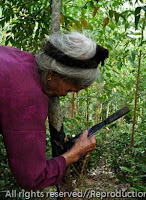
The next morning, we got up early and were lucky enough to assis the lacquer harvesting, witnesses of a timeless tradition transmitted in this family for generations.

The production and use of the lacquer is a very complex process that requires a particular know-how not learned in any school. Rather, the tapper transmits their heritage from generation to generation. And no technological development can be use : the natural resin is extremely fragile and must be harvested by hand.
So every morning, around 3am– sunlight is very damaging for the resin – the uncles leave the house and make their way to the plantation.
Two steps are necessary to complete the harvest. First the uncles must do “V” shaped incision of approximately 5cm depth directly in the trunk of the tree to collect the valuable resin. Which would explain why traditionally, tappers are called bleeder… Like maple water, the resin runs along the notch and is collect in a seashell made cup simply planted in the tree.

The resin needs to run for a few hours before the uncles can go back and collect it. This step is done by using a small brush to transfer the product in a hermetic container where it will be stored until further use. Harvesting can be carried out all year long although winter months usually prove less productive. However, a tree is never harvested two days in a row. A pause of three to fours days between each notch is necessary to allow the tree to regenerate.
Several additional stages are essential to turn the natural resin into high quality lacquer. It first needs to be filtered before it can get churned for several hours. Once that is finished, the resin must then be mixed with various types of natural oils before it is ready to use.
Next post : the origine of natural lacquer and the difficulties producer have to face. Have a good monday everyone! H.

Friday, February 22, 2008

Higher!

When came back from our nice cruise in Halong bay just in time to meet our group for what turned out to be the BEST part of this trip...

Off we were up north to the Yen Bai province for a three-day visit to the hill tribes. This visit was special in many ways: not only were we to live with som
e family of the Dao community but also were to witness the century-old tradition of lacquer harvesting.

We drove a little over three hours on the back roads north of Hanoi to reach the tapper’s hideaway. The ride took us far away from the noise and pollution of Hanoi and allowed us to saunter postcard like scenery. Next to us, the Red river, then the Clear River, and finally the Black river. To our left, the calm and grey lazy water reflects a red setting sun. To our right, field worker are slowly getting back home, walking on a dam build to protect the fields and dwellings. Magical.


We arrived at destination in Song Thao as the sun completely sets. We were obviously expected: glasses are filled as soon as we step in the courtyard next to the old tapper’s house. Our host happily hugs one of the tapper and introduces him as is “uncle”. We are here among family, the uncle smiles around and, for a second, the language barrier disappeared. After the long road, our first meal is welcome and whatever shyness one might had quickly dissolved in the general relaxed and family atmosphere. This was priceless, and this was only the beginning...
H.

Thursday, February 21, 2008

Ridding the dragon in Halong

After a few days in Hanoi we decided to get out of town and reserved a cruise in Halong Bay.

This is a very popular activity with tourists, and after being there I certainly can understand why.

Halong Bay translates into “dragon descending into the sea.” Legend has it that they bay was created by a swirling dragon tail that gouged valleys and crevasses while the dragon was fighting the chinese invasion. When the Dragon finally plunged in the sea, water filled in the wholes, thus creating this amazing landscape.

Aery looking at dusk or down, the formation offers a constantly changing landscape one could explore for days.

Cruise can very easily by hire from one the many travel agencies in Hanoi. When booking your cruise, keep in mind you’ll have to spend half a day on the road from and to Hanoi city before reaching Halong Bay. So you might want to reconsider before booking a two-day trip…


Also keep in mind that such high tourism demand put an enormous pressure on the ecosystem. If possible, try to go with one of the eco-friendly tour operator. The Ecoboat is a good alternative choice.

Well, that’s it for today. Have a good one everyone! H.

Sunday, February 17, 2008

Chilling in Hanoi

Like I said in my previous post, Hanoi can be a little bit overwhelming for us travellers. Which is why the many lakes and little peace oasis one can find all over the city.

The most famous of those might just be Hoan Kiem Lake, located right in the middle of the old quarter of Hanoi. On top of a nice little temple, your bound to see students working on their drawing skills or stopping at Ngoc Son Temple for a prayer. Surrounded by beautiful mature trees, the place can offer a beautiful shaded spot to rest.


Right next to the Ho Chi Ming mausoleum sits the Literature Temple. Founded in 1070 to honour scholars and man of literature, the temple and small garden all around it is another nice and quiet place to escape the city’s turmoil.


It is really worth it to stop by at least one of these places, even if you have very little time in the town. These are great places to just watch the world go by.

Another fun thing to do in Hanoi is to rent a motorcycle – or hire a local student for the day – and ask them to take you to some temple and pagodas outside of Hanoi city. On top of experiencing the thrill of driving in chaotic traffic, you’ll have the rare opportunity to really meet the locals. Most of the monk will indeed be more then happy to show you around in exchange of a small donation. Money definitely well spent!

Have a good Monday everyone!
H.

Wednesday, February 13, 2008

City Life : Hanoi


I'll always remember our arrival in Hanoi: it was late, dark, and as we were entering the city in a cab we notices that regardless of the late hour, people were still everywhere on the street, selling, eating, just going about their business.

As we slowly made our way to our hotel and settle in our room, it became obvious that noise would be an issue - at least for the first days...

It's as if the city never falls asleep. Or perhaps for just a few hours, somewhere between 3h00 Am and 5h00 Am, right before the loud speakers encourage us to get out of bed and stretc
h.

Pollution is another big issue in Hanoi. Usage of fuel with lead and the obsolescence of most of the vehicles on the road - not to mention their extremely high number - are the main source of air pollution. While authorities are aiming at a maximum level of 0,02 mg of suspended air particl
es by cubic meter, the reality in urban zone has been closer to the 0,04 or 0,05 for the last five years.

I guess that would explain why breathing mask are being sold as fashion accessories...

Than being said, Hanoi is fun to wander around. One of the best thing to do is to just get lost in the city's old quarter, the Hoan Kiem District. In this mazelike neighbourhood you'll find everything from century old houses to temple and a variety of stores, the best and the worst...

Originally, the neighbourhood was home to the 36 guilds of Vietnam who, in the 13th century, established themselves in this part of town. Each guild had there own designated street : one for candles, one for lan
terns, tailors had there spot and so one. In time, more and more merchants added to the original 36 streets but you'll still find a definite tendency for the merchant to regroup.

What I call the ''Embassies'' Neighbourhood - is another fun place to wander around. Located far west of the Hoan Kiem District, this area is home of Ho Chi Minh Mausoleum Complex. Unfortunately, the Mausoleum was close during our visit but we still were able to visit the park where you'll be able to visit Ho Chi Minh museum, HCM Stilt House and the One Pillar Pagoda.

This area of town is also home to many foreign embassies. Most of them establish themselves in old colonial houses. A stroll along one of those large boulevard, surrounded with century old trees and colourful colonial houses make for a refreshing afternoon.

Well, that's it for now. Next post: A few nice relaxing spot of Hanoi and more pictures. Have a good day every one!!

H.

Monday, February 11, 2008

Vietnam's many faces

Vietnam’s cultural diversity is a major selling point with tourists of all places. Specifically, visitors like to ride up to Sa Pa to brush up with the Hill tribes.

Although there are some major social issues resulting with the rise of mass tourism in this area, the experience can definitely a major highlight of your trip and is more then worthwhile. So should you decide to brush up with the montagnards, we recommend looking for smaller agencies that have the well being of the community at heart. We traveled with
Freewheelin and can only recommend them (see previous post).

In the article below, you’ll find a little more information on the country’s different tribes.
Enjoy it!

H.

***

There are many sides to any culture. Vietnam alone is rich with 53 minority ethnic groups. Counting approximately 11 millions inhabitants, the hill tribes – also called Montagnards - count for 14% of the country’s total population. Each with there own culture and way of life, they are divided in eight different ethno linguistic groups of five major linguistic families.


First there is the Austro-Asia family, which includes the Viet-Muong and Khmer-Muong groups. Regrouping 24 different tribes, this linguistic family is the most important of the country. Then we find the austronesian language family, with five different ethnic groups, and the thai-kadai family in which we found 12 ethnic groups. The sino-tibetan family counts for nine different ethnic groups. Last but not least, the Hmong-Dao family counts “only” three different ethnic groups but is none the less the largest group of Vietnam population wise.


The hill tribes have an ambivalent status in the country. On the one hand, their rights are officially recognised by the Vietnamese Socialist Party: “The State of the socialist Republic of Vietnam represents the unified State made up of all nationalities cohabiting on the Vietnamese territory. The State applies the policy of equality, unit and mutual assistance between nationalities and formally prohibits any act of discrimination and national division. Nationalities have the right to speak and write in their language, to preserve their identity like promoting their noble habits, their rites, their traditions and their culture"


The hill tribes are also well represented in the media with frequent articles on their culture and the different challenges they face. But these good words don’t seem to help with the daily poverty issue many of them face. In fact, more then 75% of all hill tribes people live in poverty whereas only 30% of the viets face the same difficulties. (Viets are members of the kinhs ethnic groups whereas Vietnamese in use to name all the country’s inhabitants. NDLR)


But in spite of the many obstacles resulting from their precarious economical situation, it is the threat of acculturation that remains their biggest challenge. Several factors are to be taken into account when trying to understand this “vietnamisation” of their way of life.


The use of Vietnamese language in school is a major issue. Another important factor is the immaterial aspect of a major part of the cultural heritage of these tribes. Moreover, only about thirty tribes have their own writing, which therefore complicates even more the safeguarding intangible heritage’s question.
Finally, the financial amounts allocated for the protection of each ethnic group’s inheritance is defined according to the size (population count) of each group. In short, the smaller the group is, the smaller the amount is.


That being said, several initiatives were recently put in place to ensure the cultural perennity of these people. Among those, the publication of books in original ethnic language, and the possibility, for certain tribes, to receive part of their educations in their mother tongue are expected to have great impacts.
In addition, the Socialist Party approached the UNESCO in order to officially recognise some hill tribes practice as official intangible world heritage. Already, the gongs culture of the central highlands Tan Nguyen tribe received the precious title. Whether this new title will actually lead to real and concrete actio
ns for the moment still remains to be seen.

Visit
We highly recommend a visit to Hanoi
Ethnographic museum to learn more about the hill tribes. Rich with many documents and interesting display – an exterior garden allows us to visit different tribes traditional houses – the permanent collection is a must!
Hanoi Ethnographic museum
Corner of Nguyen Du & Le Duan st
Phone: 0084 (4) 850 42 66
E
ntry fee