

So my april travel plan are yet again changing. Am not even sure anymore I'll go anywhere :-( Really keeping my finger cross here!
Anyhow. In my last post I was talking about the very unique experience of assisting to lacquer harvest. It then dawn on me that it might be a good idea to post a little more information on lacquer so here it is!
Chinese are the first ones who used natural lacquer as a varnish to protect their weapons. The use of the resin however quickly extended to every-day life objects and furniture thanks to its aesthetic and protective properties. Not surprising knowing that this resin forms a completely pore less and insoluble film on all natural surface it is applied on. Objects that are varnish are thus protected against light, air and most importantly time damage.
This new technique quickly extended to all of Southeast Asia. It would have appeared in Vietnam around the 15th century. There, the use of this natural varnish is quickly integrated in the country crafting tradition to the point of becoming a symbol of Vietnamese art for the rest of the world.
The production and use of the lacquer is a very complex process that requires a particular know-how not learned in any school. Rather, the tapper transmits their heritage from generation to generation. And no technological development can be use : the natural resin is extremely fragile and must be harvested by hand.
Despite all of the natural lacquer strengths, a majority of artists import synthetic varnish from China instead of using local ones, endangering traditional production and the families making a living from it. Some blame its high toxicity, sometime responsible for skin allergy. Others claims that the high price of Vietnamese varnish is part of the problem.
However, natural lacquer price is much lower in Vietnam then it is, for example, in Japan or China. And surprisingly, these countries’s lacquer production doesn’t seem to be weakening as much as Vietnam’s is. The problem thus seems to be elsewhere. Particularly at the increasing need of varnish for touristic markets and imports that requires a fast and constant supply.
Needless to say that the traditional harvesting methods are slow – a good tree gives a maximum of 200g of resin a year – and not very profitable as per the new economic standards. Artists and institutions then turn to other source to make up for the product shortage and the natural varnish can now barely hold a spot in this new competitive market.
Next post : Driving the coast down to Nha Trang
H.
Showing posts with label lacquer. Show all posts
Showing posts with label lacquer. Show all posts
Wednesday, February 27, 2008
Monday, February 25, 2008
Bleeding trees
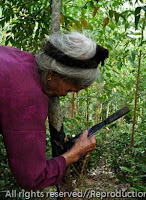 The next morning, we got up early and were lucky enough to assis the lacquer harvesting, witnesses of a timeless tradition transmitted in this family for generations.
 The production and use of the lacquer is a very complex process that requires a particular know-how not learned in any school. Rather, the tapper transmits their heritage from generation to generation. And no technological development can be use : the natural resin is extremely fragile and must be harvested by hand.
So every morning, around 3am– sunlight is very damaging for the resin – the uncles leave the house and make their way to the plantation.
Two steps are necessary to complete the harvest.  First the uncles must do “V” shaped incision of approximately 5cm depth directly in the trunk of the tree to collect the valuable resin. Which would explain why traditionally, tappers are called bleeder… Like maple water, the resin runs along the notch and is collect in a seashell made cup simply planted in the tree.
 First the uncles must do “V” shaped incision of approximately 5cm depth directly in the trunk of the tree to collect the valuable resin. Which would explain why traditionally, tappers are called bleeder… Like maple water, the resin runs along the notch and is collect in a seashell made cup simply planted in the tree.
 The resin needs to run for a few hours before the uncles can go back and collect it. This step is done by using a small brush to transfer the product in a hermetic container where it will be stored until further use. Harvesting can be carried out all year long although winter months usually prove less productive. However, a tree is never harvested 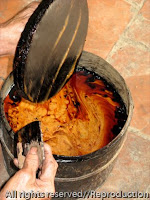 two days in a row. A pause of three to fours days between each notch is necessary to allow the tree to regenerate.
 two days in a row. A pause of three to fours days between each notch is necessary to allow the tree to regenerate.
 Several additional stages are essential to turn the natural resin into high quality lacquer. It first needs to be filtered before it can get churned for several hours. Once that is finished, the resin must then be mixed with various types of natural oils before it is ready to use.
Next post : the origine of natural lacquer and the difficulties producer have to face. Have a good monday everyone! H.


Subscribe to:
Posts (Atom)
